
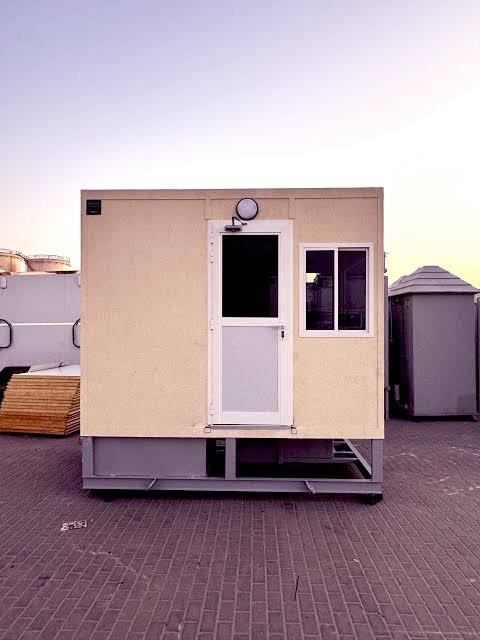
A prefabricated cabin is a building unit manufactured partly or substantially away from its final location and then transported to the required site for installation. Instead of constructing every component from the ground up at the project location, manufacturers can prepare the structural frame, wall systems, roof, insulation, flooring, electrical provisions, doors, windows, and other elements in a controlled manufacturing environment.
In the UAE, prefabricated cabins are widely associated with construction sites, industrial facilities, accommodation, security points, offices, storage areas, welfare facilities, and other applications where usable space is required quickly. UAE suppliers offer different configurations ranging from basic site offices and guard cabins to accommodation units, clinics, classrooms, kitchens, and larger modular buildings.
The basic idea is simple: manufacture more of the building off-site, transport it to the project, position it, connect the required services, and make the space ready for use. This approach can reduce the amount of construction activity required at the final location and can make it easier to provide temporary, relocatable, or customized accommodation and working spaces.
For businesses searching for a prefabricated cabin for sale UAE, understanding how these units are made, what they are used for, what features are available, and what should be checked before purchase is important.
What Is a Prefabricated Cabin?
A prefabricated cabin is a factory-produced building unit designed to be transported and installed at its intended location. Depending on the design, it may be a complete room-sized module or a structure assembled from prefabricated components.
In the UAE market, the terms prefabricated cabin, prefab cabin, portable cabin, portable building, modular cabin, and site cabin are often used for closely related products. However, the exact construction method can differ from one supplier and application to another.
A typical cabin may contain a steel structural frame, insulated wall and roof panels, flooring, doors, windows, electrical wiring, lighting, air-conditioning provisions, and plumbing where required. UAE suppliers commonly advertise galvanized or steel structural systems together with EPS, PU, rock wool, or other insulated sandwich-panel options.
The final specification depends on how the cabin will be used. A security cabin does not need the same internal arrangement as a site office. An accommodation unit requires different plumbing, electrical, ventilation, and privacy provisions from a storage cabin. A clinic or classroom can require additional requirements related to layout, accessibility, safety, and fire protection.
This is why a prefabricated cabin should not be selected only by its external appearance or basic dimensions. The intended use, site conditions, required services, insulation, fire requirements, transportation method, and local approvals all need to be considered.
How Are Prefabricated Cabins Made?
The main difference between prefabricated construction and conventional site construction is where much of the work takes place.
With conventional construction, many activities are completed directly on the project site. Prefabrication shifts a significant portion of that work into a factory or workshop environment.
Manufacturing may begin with the structural frame or chassis. Depending on the supplier and specification, the frame can be manufactured from steel or galvanized steel. Wall and roof systems are then installed, followed by insulation and interior finishes.
Electrical and plumbing systems can also be incorporated during manufacturing. Some UAE suppliers describe cabins arriving with factory-installed flooring, lighting, sockets, air-conditioning provisions, plumbing, or other fit-out components.
The general process can include:
Design and specification: The supplier establishes the cabin dimensions, layout, intended use, materials, insulation, doors, windows, electrical requirements, HVAC requirements, plumbing, and other specifications.
Structural fabrication: The structural frame, chassis, floor structure, and other supporting components are manufactured.
Wall and roof installation: Prefabricated panels or other wall and roof systems are installed.
Insulation: Thermal and acoustic insulation is incorporated according to the required specification.
Interior fit-out: Flooring, ceilings, doors, windows, electrical fixtures, lighting, partitions, and other finishes are installed.
Services: Plumbing, sanitary fittings, air-conditioning provisions, ventilation, and other systems may be incorporated depending on the cabin type.
Quality checks: The finished unit or components can be inspected before transportation.
Transportation and installation: The completed cabin or modules are transported to the project site, positioned, connected, and prepared for use.
This off-site manufacturing model is one of the main reasons modular construction can improve programme certainty. Dubai Municipality has specifically highlighted modular construction as a method that can support construction efficiency, faster project delivery, and improved building quality.
Why Are Prefabricated Cabins Popular in the UAE?
The UAE has a large construction, infrastructure, industrial, logistics, energy, hospitality, and commercial sector. Many projects require additional usable space without waiting for a conventional building to be constructed entirely on-site.
A prefabricated cabin can address this requirement by providing a factory-produced space that can be delivered and installed relatively quickly compared with building an equivalent room through conventional construction methods.
Current UAE suppliers list applications across construction, oil and gas, manufacturing, logistics, education, healthcare, government projects, remote work sites, residential developments, and other sectors.
Another reason is flexibility. A project may need an office during construction, accommodation during a remote operation, or a security cabin at an entrance. Once requirements change, some portable and modular units can be relocated or reconfigured.
This flexibility makes prefab cabins particularly useful where the duration or future location of a facility may change.
How Are Prefabricated Cabins Used in the UAE?
The applications of prefab cabins are broad. The correct configuration depends on the project and the purpose of the space.
Prefabricated Site Office Cabins
Construction projects often need dedicated spaces for engineers, supervisors, consultants, project managers, and administrative staff.
A site office cabin can provide a controlled workspace near the construction activity without requiring a conventional permanent office building.
Depending on requirements, an office cabin can include:
- Workstations
- Internal partitions
- Lighting
- Electrical sockets
- Air conditioning
- Data and communication provisions
- Meeting areas
- Storage
- Windows and doors
UAE suppliers specifically market portable offices and site cabins for construction and industrial projects.
Prefabricated Accommodation Cabins
Accommodation cabins can provide sleeping and living spaces for workers, staff, engineers, or other personnel where permitted and approved for the intended use.
These units can be designed with bedrooms, bathrooms, kitchens, storage, air conditioning, and other facilities. Some suppliers offer single, twin, multi-person, and dormitory configurations.
However, accommodation should not be treated as interchangeable with a basic site office. Local planning, building, health, safety, and accommodation requirements must be checked before using a cabin for residential or workforce accommodation.
For example, Ras Al Khaimah’s building regulation specifically restricts caravans, prefabricated lightweight structures, and temporary buildings for labour accommodation use in the circumstances covered by that regulation.
Therefore, the intended use and local authority requirements should be established before purchasing or installing an accommodation cabin.
Security and Guard Cabins
Security cabins are compact prefabricated units designed for guards and access-control personnel.
They can be installed at:
- Construction entrances
- Industrial facilities
- Warehouses
- Residential compounds
- Commercial properties
- Parking areas
- Gated developments
A security cabin may include viewing windows, a counter or desk, lighting, electrical outlets, air-conditioning provisions, and a secure door.
Because security personnel may remain in the cabin for long periods, ventilation, thermal insulation, visibility, lighting, and comfortable working conditions are important considerations.
Storage Cabins
Prefabricated storage cabins can provide additional protected space for tools, equipment, documents, materials, and other items.
They can be useful on construction and industrial sites where the project requires storage close to the work area.
A storage cabin should be selected according to the type and quantity of materials being stored. Security, ventilation, moisture protection, access, floor loading, and fire requirements can all influence the specification.
Portable Classrooms and Training Spaces
Modular construction can also be used for educational facilities and training environments.
UAE prefab suppliers list portable classrooms and training spaces among modular applications. These units can be designed with suitable room layouts, lighting, electrical systems, ventilation, insulation, and other requirements appropriate to their intended use.
Medical and Clinic Cabins
Prefabricated modules can also be configured as clinics, treatment rooms, first-aid spaces, or other healthcare-related facilities.
A medical cabin requires more than simply installing partitions inside an ordinary office cabin. Layout, hygiene, electrical systems, ventilation, plumbing, accessibility, fire safety, and applicable healthcare requirements need to be considered.
Some UAE modular suppliers specifically offer portable clinics with consultation, treatment, reception, and related layouts.
Toilet, Shower, and Welfare Cabins
Construction and remote projects can require dedicated welfare facilities.
Prefabricated toilet and shower units can be manufactured with sanitary fittings, water systems, waste systems, ventilation, lighting, and other necessary services.
These units can be supplied independently or as part of a larger site accommodation or welfare complex.
Retail and Commercial Cabins
Prefab structures can also be configured as kiosks, small retail spaces, ticket booths, cafés, reception units, and customer service areas.
The advantage is that the building shell and many interior components can be manufactured before delivery, allowing the final site work to concentrate on placement and service connections.
Industrial and Remote-Site Facilities
The UAE’s industrial and energy sectors often operate in locations where constructing conventional buildings may be inconvenient or time-consuming.
Prefab cabins can be designed as:
- Control rooms
- Site offices
- Equipment rooms
- Staff facilities
- Security units
- Stores
- Welfare facilities
- Accommodation modules
UAE suppliers currently list applications across oil and gas, manufacturing, logistics, infrastructure, marine, and remote projects.
Are Prefabricated Cabins Suitable for the UAE Climate?
Climate performance is one of the most important considerations when selecting a prefabricated cabin for sale UAE.
The UAE experiences very hot summers, strong solar exposure, dust, and humidity in coastal areas. A cabin intended for regular occupancy therefore needs an appropriate building envelope and cooling strategy.
Manufacturers operating in the UAE commonly specify insulated sandwich panels, insulated roofs, weather-resistant systems, and air-conditioning provisions for portable cabins.
Insulation helps reduce heat transfer through the cabin envelope. However, insulation alone does not make a cabin comfortable. The overall design also needs to consider:
Roof construction: The roof is directly exposed to strong solar radiation and therefore plays an important role in thermal performance.
Wall insulation: The wall build-up and insulation material affect heat transfer and indoor comfort.
Windows: Glass area, glazing specification, shading, and window orientation can influence heat gain.
Air conditioning: The cooling system needs to be appropriately selected for the cabin size, occupancy, equipment load, and site conditions.
Ventilation: Occupied spaces require appropriate ventilation in addition to cooling.
Sealing: Gaps and poorly sealed openings can affect both comfort and dust control.
External finish: Reflective or weather-resistant exterior systems can be used as part of an overall climate strategy.
Some UAE manufacturers offer EPS, PU, and rock wool sandwich-panel options, while others specify rock wool or other insulation systems according to project requirements.
The important point is that buyers should evaluate the complete thermal system, rather than choosing a cabin based only on a claim that it is “heat resistant.”
What Materials Are Used in Prefabricated Cabins?
There is no single material specification for every prefab cabin.
The structure can use steel or galvanized steel, while walls may use insulated sandwich panels or other composite systems. Flooring can range from vinyl finishes to ceramic or other durable surfaces depending on the application.
Commonly advertised components in UAE prefab cabins include:
Steel or galvanized steel frames: Provide the primary structural support.
Insulated sandwich panels: Can provide both thermal and acoustic insulation.
Rock wool: Often selected where enhanced fire and acoustic performance is required.
EPS or PU panels: Common insulation options used in different cabin systems.
Aluminium windows: Used in many portable and modular cabin configurations.
Steel doors: Suitable where security and durability are important.
Vinyl or ceramic flooring: Selected according to the intended use and required durability.
Electrical systems: Can include distribution boards, sockets, switches, lighting, and other provisions.
The exact specification varies considerably between suppliers and projects, so buyers should request a written technical specification instead of relying on a product name alone.
What Are the Benefits of Prefabricated Cabins?
Faster Deployment
Because much of the cabin is manufactured before arriving at the site, installation can be significantly faster than constructing an equivalent space from basic materials at the project location.
The exact delivery period depends on whether the cabin is standard or customized, whether it is available from stock, the project quantity, transportation requirements, and the necessary approvals.
Controlled Manufacturing
Factory production provides a more controlled environment for fabrication and fit-out.
Modular construction can allow electrical, plumbing, interior, and structural work to be coordinated before the unit reaches the site.
Dubai Municipality’s recent approval of a modular construction system reflects the UAE’s continued interest in modern construction methods that can improve efficiency and project delivery.
Flexible Design
Prefabricated cabins are available in different dimensions, layouts, and configurations.
A buyer may be able to request internal partitions, bathrooms, kitchens, storage areas, counters, additional windows, electrical points, air-conditioning provisions, or other features.
Relocation Potential
Portable cabins are designed with transportation in mind. Depending on their structural design and site installation, some units can be moved to another location when a project changes.
This can be valuable for construction companies and businesses with temporary or changing site requirements.
Reduced Site Disruption
Because significant manufacturing takes place away from the final site, there can be less on-site fabrication, cutting, and associated activity.
This can be particularly useful on operating industrial sites or busy construction projects where space and access are limited.
Scalable Space
Modular systems can sometimes be combined to create larger facilities.
A project may start with a single office cabin and later require additional offices, meeting rooms, welfare units, or accommodation modules.
The ability to combine modules depends on the structural system and supplier’s design.
Prefabricated Cabin vs Traditional Construction
A prefabricated cabin is not automatically better than conventional construction for every project.
The correct option depends on the project duration, required building size, land conditions, intended use, approvals, budget, and long-term plans.
Traditional construction may be more appropriate where a highly permanent building with extensive architectural requirements is needed.
A prefabricated or modular solution can be attractive where speed, repeatability, flexibility, relocation, and controlled manufacturing are important.
The decision should therefore be based on the project requirements rather than simply comparing the initial purchase price.
Prefabricated Cabin vs Portable Cabin: Is There a Difference?
The terms can overlap.
A prefabricated cabin describes how the structure or its components are manufactured: significant portions are produced before reaching the final site.
A portable cabin emphasizes the ability to transport or relocate the unit.
A modular cabin can be prefabricated and portable, although not every prefabricated building is necessarily designed to be repeatedly relocated.
UAE suppliers commonly use these terms interchangeably in their product descriptions, particularly for site offices, security cabins, accommodation units, and other relocatable structures.
For buyers, the more important question is not the terminology but whether the actual cabin meets the project’s structural, thermal, electrical, fire, planning, and operational requirements.
What Should You Check Before Buying a Prefabricated Cabin in the UAE?
If you are looking for a prefabricated cabin for sale UAE, do not make the decision based solely on photographs or advertised dimensions.
Start with the intended use.
A cabin for an office requires a different specification from one intended for accommodation, storage, security, healthcare, or industrial operations.
Then check the structural specification. Ask about the frame material, chassis, wall system, roof construction, floor structure, and expected loading.
The insulation specification should also be clear. Ask which insulation material is being used, where it is installed, and whether the roof and floor are insulated as well as the walls.
Electrical requirements should be documented, particularly if the cabin will contain air conditioners, refrigerators, computers, water heaters, kitchen equipment, or other high-load appliances.
If plumbing is required, confirm the water supply, drainage, sanitary fixtures, tanks, pumps, and connection requirements.
For occupied cabins, check ventilation and air-conditioning provisions.
Fire safety is another important consideration. Requirements can vary according to the emirate, location, building classification, occupancy, and intended use. Do not assume that a generic “fire-rated” statement automatically means a cabin is approved for every application.
Dubai’s regulatory framework gives the relevant municipal authority responsibilities covering building regulations, permits, inspections, and permanent and temporary structures.
For a project in another emirate, the relevant local authority requirements should be checked separately.
Do Prefabricated Cabins Need Approval in the UAE?
There is no single blanket answer that applies to every cabin in every location.
Requirements can depend on the emirate, plot, land use, building type, cabin purpose, duration of use, utilities, occupancy, and project conditions.
For example, Dubai’s regulations specifically address temporary uses and include temporary offices at construction projects and temporary security rooms, subject to the applicable requirements and other legislation.
Dubai Municipality is also responsible for systems covering construction and building permits and for monitoring permanent and temporary buildings and structures.
This means a buyer should confirm the approval process with the relevant authority or qualified consultant before placing a cabin on a site.
A supplier should also be able to provide technical information needed for the approval process where applicable.
How Long Can a Prefabricated Cabin Last?
The service life of a prefab cabin cannot be stated accurately using one universal number.
It depends on:
- Structural materials
- Corrosion protection
- Panel quality
- Roof construction
- Insulation
- Installation quality
- Foundation or support arrangement
- Exposure to weather
- Frequency of relocation
- Maintenance
- Intended use
A well-designed cabin manufactured from appropriate materials and properly maintained can provide long-term service, but buyers should ask the supplier for the expected service life and warranty for the specific construction system rather than relying on generic industry claims.
Regular inspection is particularly important in the UAE environment. Roofs, seals, external panels, steel components, air-conditioning systems, electrical equipment, plumbing, and drainage should be maintained according to their requirements.
Can Prefabricated Cabins Be Customized?
Yes. Customization is one of the important advantages of modern modular cabin systems.
Depending on the supplier, a cabin can be configured around:
- Number of rooms
- Internal partitions
- Doors and windows
- Electrical points
- Lighting
- Air conditioning
- Bathrooms
- Kitchens
- Counters
- Storage
- Flooring
- Wall finishes
- External branding
- Canopies and steps
UAE suppliers currently advertise both standard cabins and custom-built units designed around customer drawings or specific layouts.
However, extensive customization can affect price, manufacturing time, transportation, and installation requirements.
For this reason, it is better to prepare the required layout and specification before requesting a quotation.
Are Prefabricated Cabins Suitable for Permanent Use?
A prefabricated structure is not automatically temporary simply because it was manufactured off-site.
Some modular buildings are designed for long-term use, while others are specifically produced for temporary applications.
The distinction depends on the design, materials, foundation, intended use, local approvals, and applicable regulations.
A business considering a prefab cabin for long-term use should therefore ask:
Is the unit designed for the intended duration?
Is the proposed use permitted on the site?
Does the cabin meet applicable building and fire requirements?
Can utilities be connected properly?
What maintenance will be required?
What warranty is provided?
These questions are more useful than simply classifying a cabin as “temporary” or “permanent.”
Who Should Consider Buying a Prefabricated Cabin in the UAE?
A prefabricated cabin for sale UAE can be considered by organizations that need additional usable space without constructing an entire conventional building.
Potential users include:
Construction companies needing project offices, security points, welfare facilities, storage, or accommodation.
Industrial companies requiring offices, control rooms, stores, security cabins, or staff facilities.
Logistics businesses needing site offices, security units, and operational spaces.
Oil and gas companies requiring modular facilities for remote or industrial locations.
Educational organizations requiring additional classrooms or training spaces.
Healthcare operators requiring suitable modular medical facilities where permitted.
Commercial businesses needing kiosks, offices, reception spaces, or temporary facilities.
Property owners looking for additional modular rooms or facilities, subject to applicable planning and building requirements.
How Does the Buying Process Work?
The buying process should begin with a clear specification rather than simply asking for the cheapest available cabin.
First, identify the purpose of the unit.
Next, determine the required dimensions and layout.
Then identify the required services, such as electricity, air conditioning, plumbing, drainage, lighting, data, kitchen facilities, or bathrooms.
After that, establish the site conditions. The supplier needs to know where the cabin will be installed, how it will be transported, how it will be lifted or positioned, and how utilities will be connected.
The supplier can then prepare a technical and commercial quotation.
For a customized cabin, the quotation should clearly identify materials, dimensions, insulation, finishes, electrical systems, HVAC provisions, plumbing, delivery, installation, warranty, and exclusions.
This makes it easier to compare suppliers on a genuine like-for-like basis.
What Affects the Price of a Prefabricated Cabin in the UAE?
There is no single standard price because prefab cabins vary significantly in size and specification.
Important price factors include:
Cabin size: Larger units generally require more structural materials, panels, flooring, and finishing.
Layout: A simple open office costs differently from a multi-room cabin with bathrooms and a kitchen.
Insulation: Different insulation systems and thicknesses can affect material and performance.
Interior finishing: Flooring, ceilings, partitions, joinery, and decorative finishes affect the final specification.
Electrical requirements: Lighting, sockets, distribution boards, data systems, and high-load equipment can increase the scope.
HVAC: Air-conditioning equipment and installation add to the project cost.
Plumbing: Bathrooms, kitchens, water systems, and drainage require additional materials and installation.
Fire and safety requirements: Specialized materials and systems can affect the price.
Transportation: Delivery distance, cabin dimensions, access, and lifting requirements influence logistics.
Installation: Site preparation, crane services, connections, and commissioning may be included or charged separately.
For this reason, a very low advertised starting price should not be compared directly with a fully fitted cabin quotation.
What Makes a Good Prefabricated Cabin for the UAE?
A good cabin is not simply the cheapest or the fastest option.
For UAE conditions, the cabin should be appropriately designed for its intended environment and use.
The structure should be suitable for transportation and installation. The envelope should provide appropriate thermal and weather protection. Insulation should match the required performance. Electrical and HVAC systems should be properly designed. Finishes should be suitable for the expected occupancy and maintenance conditions.
For applications involving public access, accommodation, healthcare, education, or other regulated uses, the relevant authority requirements should also be incorporated into the design.
A reputable supplier should be able to explain the technical specification instead of relying only on general marketing terms such as “premium,” “heavy duty,” or “weatherproof.”
Why Prefabricated Cabins Are Becoming an Important Modular Building Option in the UAE
The UAE construction sector continues to explore methods that can make building delivery more efficient and adaptable.
Dubai Municipality’s June 2026 announcement regarding approval of a modular construction system is a recent example of the UAE’s continued adoption of modern construction approaches. The authority said the approval supports construction efficiency, faster project delivery, and building quality.
Prefabricated cabins represent one practical part of this broader modular construction approach.
They can provide ready-to-use space for construction projects, industrial facilities, businesses, remote operations, and other applications. Their value comes from combining off-site manufacturing, flexible layouts, transportability, and faster site installation.
At the same time, prefab should not be treated as a one-size-fits-all solution. A successful project depends on choosing the correct construction system, specifying the right materials, understanding the site requirements, and confirming applicable approvals.
Final Thoughts
A prefabricated cabin is a factory-manufactured building unit that can be transported to a project site and installed for a specific purpose. In the UAE, these cabins are used for site offices, security facilities, accommodation, storage, welfare spaces, classrooms, clinics, commercial units, and various industrial applications.
Their popularity comes from practical advantages such as faster deployment, controlled manufacturing, flexible layouts, potential relocation, and reduced on-site construction work.
For anyone searching for a prefabricated cabin for sale UAE, the most important step is to start with the intended application. A cabin designed for a construction office will have different requirements from an accommodation unit, medical cabin, security room, or industrial facility.
Before buying, compare the structural frame, insulation, roof, flooring, electrical system, HVAC provisions, plumbing, fire-safety specification, customization options, transportation, installation, warranty, and approval requirements.
With the right specification and proper site planning, prefabricated cabins can provide a practical and adaptable space solution for many UAE projects.
Frequently Asked Questions
What is a prefabricated cabin in the UAE?
A prefabricated cabin is a building unit or modular structure manufactured partly or substantially away from its final location and then transported and installed at the required site. It can be configured as an office, accommodation unit, security cabin, storage facility, classroom, clinic, or other type of space.
What are prefabricated cabins used for in the UAE?
They are commonly used for site offices, security cabins, accommodation, storage, welfare facilities, classrooms, clinics, retail spaces, and industrial or remote-site facilities. UAE suppliers currently list applications across construction, oil and gas, manufacturing, logistics, education, healthcare, and other sectors.
Are prefabricated cabins suitable for UAE weather?
They can be, provided they are properly designed and specified for the local conditions. Insulation, roof construction, windows, air conditioning, ventilation, sealing, and weather-resistant materials all contribute to indoor performance.
Can I buy a customized prefabricated cabin in the UAE?
Yes. Many suppliers offer customized layouts and specifications. Options can include partitions, bathrooms, kitchens, electrical systems, air conditioning, flooring, windows, doors, and other features.
Can prefabricated cabins be relocated?
Some prefabricated and portable cabins are specifically designed for transportation and relocation. Whether a particular unit can be moved safely depends on its structural design, installation method, dimensions, and transportation requirements.
Are prefabricated cabins only for temporary projects?
No. Some are designed for temporary applications, while others are manufactured for longer-term use. The appropriate solution depends on the cabin design, intended use, site conditions, and applicable regulations.
Do I need approval before installing a prefabricated cabin in the UAE?
Approval requirements vary according to the emirate, location, land use, cabin purpose, occupancy, and project conditions. In Dubai, municipal authorities regulate building permits and inspect permanent and temporary structures, while local requirements in other emirates can differ.
What should I check before buying a prefabricated cabin?
Check the structural frame, dimensions, insulation, roof, flooring, electrical system, air conditioning, plumbing, doors, windows, fire-safety requirements, transportation, installation, warranty, and applicable approvals. Most importantly, ensure the cabin is designed for its intended use.
What factors affect prefabricated cabin prices in the UAE?
Size, layout, structural materials, insulation, interior finishes, electrical systems, HVAC, plumbing, fire-safety requirements, customization, transportation, and installation can all affect the final price.
Is a prefabricated cabin better than traditional construction?
It depends on the project. Prefabricated cabins can be advantageous when speed, flexibility, controlled manufacturing, and potential relocation are important. Traditional construction may be more suitable for projects requiring a highly permanent building or extensive architectural customization.